

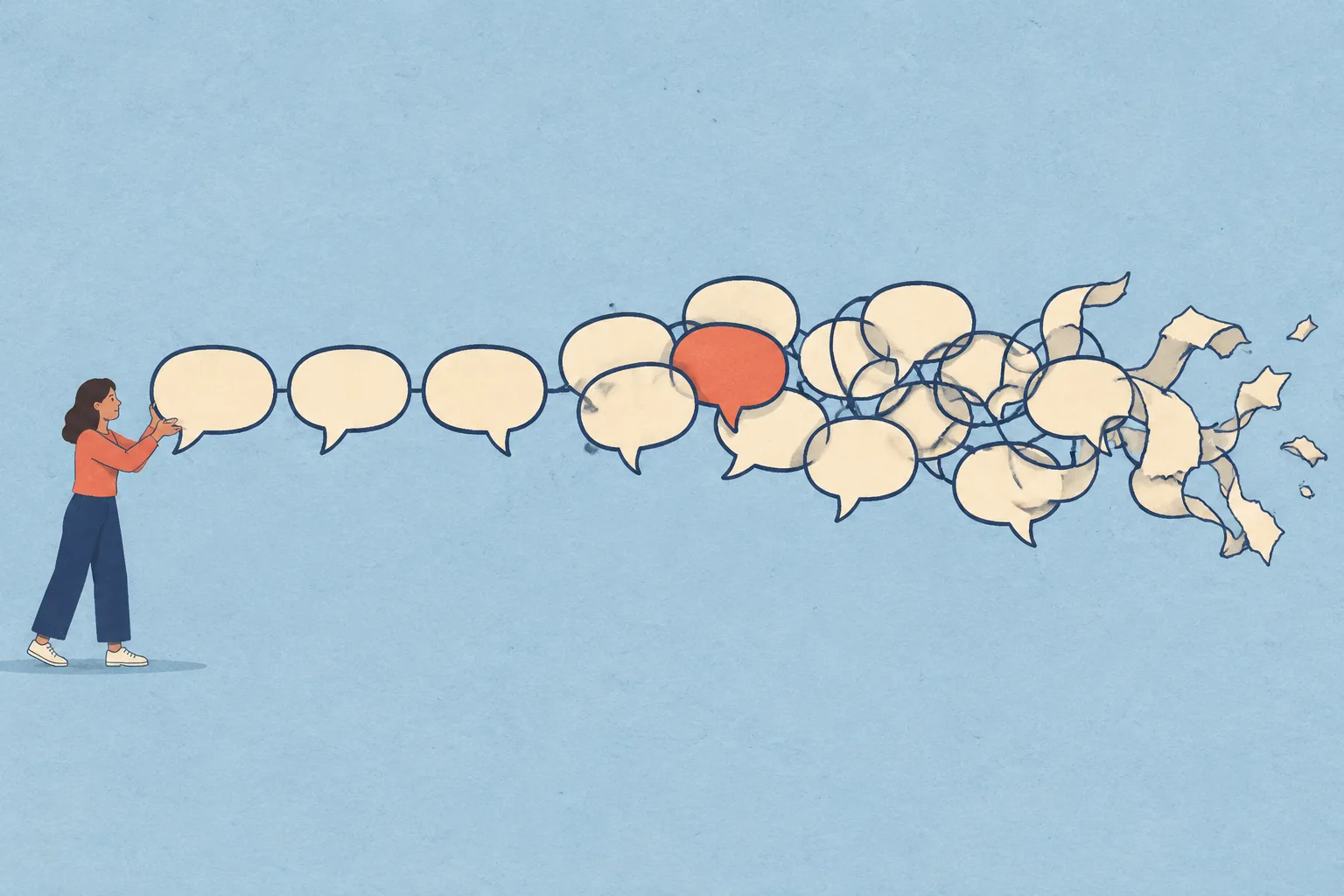
Five people type into a channel at 9:04 a.m. By 9:40 the thread holds forty-one messages, two apologies for lateness, one "quick question" that spawns a side thread, and a status update that reads, in full, "Still working on the thing from yesterday." Nobody reads past message twelve. The standup happened. The momentum did not.
Async standups were supposed to fix the meeting that eats the morning. Replace the circle of chairs with a written thread, let people post when their brain actually turns on, keep a searchable record. All reasonable. What gets lost in the migration is that a standup is a coordination instrument, and a coordination instrument degrades the moment its format stops forcing decisions. The meeting version fails loudly, with visible sighs. The async version fails quietly, one polite message at a time, and the team keeps posting long after the ritual has stopped doing any work.
Five failure patterns account for most of the drift. None of them look like mistakes while they are happening.
The status report that never asks for anything
The classic async update describes the past. Finished the migration script. Reviewed two pull requests. Started reading the billing docs. Every sentence faces backward, and backward-facing sentences cannot unblock anyone.
A standup earns its place in the day by surfacing what is stuck and what is about to collide. When the template only asks what happened, people answer honestly and uselessly. The blocked engineer writes "still investigating the timeout" and the team reads it as progress. Three days later the same sentence appears, slightly reworded, and nobody notices the repetition because nobody is scanning for it.
The fix is structural: require each update to name one thing the person needs from someone else, even if the answer is "nothing today." The word "nothing" is fine. The requirement to write it forces a half-second of reflection that the free-form paragraph skips entirely.
Updates timed for the sender's convenience
Async does not mean anytime. A team that lets people post whenever tends to get a long tail of updates arriving between 2 and 5 p.m., well after the people who needed to read them have made their morning decisions.
There is a real tension here, and it is worth naming plainly: the whole appeal of the format is that it respects different schedules. Someone doing deep work at 7 a.m. and someone wrangling school drop-off at 8:30 should both be able to participate. But a coordination window that stretches across the entire working day stops coordinating anything. The information arrives too late to change the shape of the day it describes.
A narrow posting window, say before 10 a.m. local, preserves most of the flexibility while keeping the updates useful for the people planning their afternoon. The stragglers can post late, but the team should treat a 3 p.m. standup entry the way it would treat a 3 p.m. meeting invite: technically allowed, socially discouraged.
The thread that becomes a second inbox
Here is where async standups quietly turn into a tax. The daily thread starts as five updates. Then someone replies to an update with a question. Then the original poster answers. Then a third person chimes in with context. Then a fourth person asks whether this affects the release. By noon the thread has three simultaneous conversations braided together, and the person who skimmed it at 9:15 has to re-read the whole thing to find the two lines that concern them.
The standup has become a chat room with a daily reset. The cost is invisible because it is spread across everyone: fifteen minutes here, twenty there, every person on the team paying the re-read tax. Multiply by five people and the ritual that was supposed to save the morning has started consuming it.
The discipline that prevents this is old and unglamorous. The daily thread holds updates only. Any reply that turns into a discussion gets moved to its own thread or channel within one message. The standup channel stays a log, not a forum.
Blockers announced into the void
An engineer writes, "Blocked on the API credentials from the platform team." Then nothing happens. The message sits in the thread, read by people who cannot help, while the engineer waits, assuming the announcement was enough.
This is the cruelest of the five because it looks like good practice. The blocker was surfaced. The team was informed. And yet the work stays stuck, because surfacing and routing are different acts, and the async format makes it easy to confuse the first for the second.
A blocker needs an owner and a deadline attached at the moment it is posted, or it is just a complaint with good formatting. "Blocked on API credentials, pinged Dana directly, need them by Thursday to keep the release on track" is a different message from "blocked on API credentials." The first one has a path. The second one has a hope.
Teams that run async standups well tend to have a rule about this: a blocker without a named person and a named date gets flagged by whoever reads it first, usually the lead, who replies with a single question, "Who is chasing this?" That question, asked consistently, retrains the habit within a couple of weeks.
The silent majority who skip the ritual
Async standups have a participation problem that meetings do not. In a meeting, absence is visible. In a channel, absence is a scroll past. The engineer who posts nothing for a week is easy to miss, and the reasons for silence are usually benign: busy, heads-down, nothing interesting to report.
The problem is that the silent members are often the ones whose status matters most. The person who is quietly stuck. The person whose work has drifted from the plan. The person who is about to leave. A standup exists partly to make those situations visible early, and a format that lets people opt out silently defeats that purpose.
One team I know handles this with a light touch: the standup bot posts a list of who has not updated by 11 a.m., no commentary, just names. It reads as a nudge rather than a reprimand, and it makes the absence visible without making it a confrontation. Participation went from roughly two-thirds to nearly universal within a month, mostly because people did not want to be on the list.
When the ritual outlives the reason it existed
The deeper failure underneath all five is that async standups, once installed, rarely get re-examined. The meeting version dies when it stops being useful because someone in the room says so out loud. The channel version persists because nobody has to attend it, and a ritual nobody attends is a ritual nobody evaluates.
A useful test, run every quarter or so: pull the last two weeks of standup threads and count how many decisions actually came out of them. Not how many messages, not how many blockers mentioned, but how many things changed because someone read the thread. If the count is zero, the ritual has become a form of documentation theater, and the team is paying the tax without collecting the benefit.
The fix at that point is not to abolish the standup. It is to change what the thread is for. Some teams get more value from a weekly written update and a separate real-time channel for blockers. Others need the daily rhythm but with a much shorter form: three lines, posted before 10, no replies. The point is to keep the instrument matched to the job, and to notice when the instrument has quietly stopped working.
Momentum dies in these channels the way a fire dies in a sealed room: no single dramatic moment, just the slow consumption of the oxygen. The thread stays green. The messages keep arriving. And one morning the team realizes the standup has been happening for months without anyone remembering the last time it changed a decision. That realization is the only signal that matters, and it usually arrives too late to be comfortable.